
Sunday, September 16, 2012
Air Transat advertisement
An advertisement of Air Transat on a public billboard that I photographed. Click on image to enlarge:


Thursday, February 23, 2012
Why I prefer HerpaWings and Aeroclassics to DragonWings.
I'm not such an avid collector of scale models as I used to be, nor do I collect models in airline livery since it's the plane I'm after, not the airline or unless it's an airline I've been on.
But occasionally it's nice to own a model of a beautiful and highly ranked plane. I used to prefer large 1:200 snap fit models regardless of the brand as long as the quality was good. But there were a few issues sticking to 1:200 snap fits. One was that they lacked detail and accuracy. And that shouldn't be surprising given they are made of plastic as opposed to the metal that 1:400 diecast models are made of. The second was that there are models of classic aircraft not available in 1:200 scale.
Also another problem is 1:200 snap-fit models of classic wide body airliners are rare to find. Others of classic wide-body planes don't even exist.
So when I'm forced to choose between diecast models, I realize the mistake I made by purchasing DragonWings models. Not only are they highly priced, but they're also delicate and require their landing gears to be fitted in.
Aeroclassics are expensive also, but they come with their landing gears attached and their build is much more solid.
The same is true for Herpa Wings with their models coming not only with full attached landing gears but also their wheels rotate. The only thing I don't like about Herpa Wings is their 1:600 scale models which are cheap in quality and almost identical to the unpopular Schabak. DragonWings on the other hand seem to produce models with delicate wings, landing gears that need to be attached and can get lost easily and overall expensive planes.
Herpa Wings can also be small in their 1:500 scales, but I actually realize they are still great quality and more solid than Dragon Wings models and less pricey. Upon this analysis, I would recommend collectors not to go after dragon wings models. It's simply not worth the price, especially after the landing gears get lost or the delicate thin wings break off.
But occasionally it's nice to own a model of a beautiful and highly ranked plane. I used to prefer large 1:200 snap fit models regardless of the brand as long as the quality was good. But there were a few issues sticking to 1:200 snap fits. One was that they lacked detail and accuracy. And that shouldn't be surprising given they are made of plastic as opposed to the metal that 1:400 diecast models are made of. The second was that there are models of classic aircraft not available in 1:200 scale.
Also another problem is 1:200 snap-fit models of classic wide body airliners are rare to find. Others of classic wide-body planes don't even exist.
So when I'm forced to choose between diecast models, I realize the mistake I made by purchasing DragonWings models. Not only are they highly priced, but they're also delicate and require their landing gears to be fitted in.
Aeroclassics are expensive also, but they come with their landing gears attached and their build is much more solid.
The same is true for Herpa Wings with their models coming not only with full attached landing gears but also their wheels rotate. The only thing I don't like about Herpa Wings is their 1:600 scale models which are cheap in quality and almost identical to the unpopular Schabak. DragonWings on the other hand seem to produce models with delicate wings, landing gears that need to be attached and can get lost easily and overall expensive planes.
Herpa Wings can also be small in their 1:500 scales, but I actually realize they are still great quality and more solid than Dragon Wings models and less pricey. Upon this analysis, I would recommend collectors not to go after dragon wings models. It's simply not worth the price, especially after the landing gears get lost or the delicate thin wings break off.
Thursday, December 29, 2011
Making salute ceremonies less wasteful

As seen in the above photo of airport fire engines giving a salute ceremony to an airline upon it's first arrival. It appears to be an airport in Washington DC, but it doesn't really matter where it is. The problem here is fresh water being used to give the plane a salute ceremony is being wasted and falling into concrete.
At first I was completely against the idea of giving salute ceremonies because water gets wasted. And in a world of more than seven billion people, wasting a natural resource like water is simply unethical.
But then I had an idea. If the water canons were set to shoot water where it would fall on the grass it would save watering them for one day at the same time give a proper salute ceremony.
Saturday, November 19, 2011
PAF developing "Super F-16" :: F-16.net
An interesting piece of news:
PAF developing "Super F-16" :: F-16.net
PAF developing "Super F-16" :: F-16.net
Hyderabad airport needs a cargo terminal
Back in June the agriculture minister of Sindh proposed turning Hyderabad into an international and cargo airport.
Also according to my memory, former Prime Minister Zafarullah Khan Jamali made the same proposal during his time in office as the Prime Minister of Pakistan.
I could not agree anymore. Though I still think we need to grow the domestic aviation cargo market before thinking so far ahead. Flights should be launched from Hyderabad to destinations in the Balochistan province as well as Pakhtunkhwa and Punjab. Items from ginger to produce non-alcoholic beer to other agricultural products.
Instead of transporting these products to the sea port in small amounts and in so many trucks, they should just be all packed into a cargo plane and flown directly to the Gulf.
The cargo terminal could also provide a direct cargo air route from Hyderabad to other major cities in Pakistan further away in the north like Lahore, Islamabad, Peshawar etc.
This would also save farmers the burden of having to ship them all the way to Karachi. The trucks transporting them could also be used for transporting other things instead.
Transporting agricultural products by air also allows the food to be fresh upon reaching it's journey. Having a cargo terminal at Hyderabad airport will also improve the city's economy and provide job opportunities to local people in Hyderabad weather as airport security officials or on loading/off loading cargo onto aircraft.
The cargo terminal could also bring large amounts of products directly into Hyderabad much faster via air. It would also boost Sindh's agricultural economy.
These are few examples of the wonders a cargo terminal at Hyderabad airport can do. The terminal should not be that big or take up too much natural land. Nor should there be heavy traffic, but a small and sizable amount of traffic, enough to meet local and international demand.
By all means Hyderabad airport could do much good with a cargo terminal.
Also according to my memory, former Prime Minister Zafarullah Khan Jamali made the same proposal during his time in office as the Prime Minister of Pakistan.
I could not agree anymore. Though I still think we need to grow the domestic aviation cargo market before thinking so far ahead. Flights should be launched from Hyderabad to destinations in the Balochistan province as well as Pakhtunkhwa and Punjab. Items from ginger to produce non-alcoholic beer to other agricultural products.
Instead of transporting these products to the sea port in small amounts and in so many trucks, they should just be all packed into a cargo plane and flown directly to the Gulf.
The cargo terminal could also provide a direct cargo air route from Hyderabad to other major cities in Pakistan further away in the north like Lahore, Islamabad, Peshawar etc.
This would also save farmers the burden of having to ship them all the way to Karachi. The trucks transporting them could also be used for transporting other things instead.
Transporting agricultural products by air also allows the food to be fresh upon reaching it's journey. Having a cargo terminal at Hyderabad airport will also improve the city's economy and provide job opportunities to local people in Hyderabad weather as airport security officials or on loading/off loading cargo onto aircraft.
The cargo terminal could also bring large amounts of products directly into Hyderabad much faster via air. It would also boost Sindh's agricultural economy.
These are few examples of the wonders a cargo terminal at Hyderabad airport can do. The terminal should not be that big or take up too much natural land. Nor should there be heavy traffic, but a small and sizable amount of traffic, enough to meet local and international demand.
By all means Hyderabad airport could do much good with a cargo terminal.
Wednesday, November 16, 2011
Latest addition to my collection
Airbus 300-600 by Herpa Wings. The scale is quite a bit small at 1:500 but it's still fairly detailed and even has moving wheels unlike the Dragon Wings models (click on images to enlarge).


Wednesday, October 19, 2011
Saving stored planes for back up and relief operations
I was recently watching some YouTube videos and reading of incidents involving PIA flights being stranded at unscheduled stops due to technical problems.
Not only was the plane unable to continue the flights due to these technical problems but the passengers on the flight were stranded along with the crew. Passengers expected to fly on the plane on the return journey on the plane back to Pakistan were also delayed for hours.
PIA was forced to send another plane with a relief crew to repaid the faulty plane and to pick the stranded passengers, only adding to financial losses by the airline.
I know it doesn't happen that often that a plane is stranded due to technical or other problems and is forced to suspend it's flight, but when it does happen the consequences can be devastating.
Using the PIA case as an example, it got me thinking why airlines don't used stored planes as backups in case a plane is stranded far away. Take for example Gulf Air's recent storage of their B767-300s to save maintainance costs. If I'm not mistaken, Gulf Air's route network is small so it did not need it's B767-300s.
But suppose Gulf Air had an incident of stranding the plane. A stored B767-300 of theirs could be dispatched to transport the relief crew and pick stranded passengers without diverting planes already in use and scheduled for other flights.
PIA also had temporarily grounded it's B747s to save fuel costs. While being grounded, the 747s should still have been equipped and left prepared to meet any emergency needs in order to minimize disruption.
PIA has a crew of experienced captains and crew members to operate B747s and to keep crew members of grounded aircraft types up to date, airlines should use flight simulators.
I've also read unconfirmed comments from various individuals that Qatar Airways plans on selling it's Airbus 340-600s as soon as it inducts the Airbus 380. If Qatar Airways was wise enough it would keep a few Airbus 340-600 for emergency situations.
This will help during unexpected emergency situations no matter how rarely they occur.
Not only was the plane unable to continue the flights due to these technical problems but the passengers on the flight were stranded along with the crew. Passengers expected to fly on the plane on the return journey on the plane back to Pakistan were also delayed for hours.
PIA was forced to send another plane with a relief crew to repaid the faulty plane and to pick the stranded passengers, only adding to financial losses by the airline.
I know it doesn't happen that often that a plane is stranded due to technical or other problems and is forced to suspend it's flight, but when it does happen the consequences can be devastating.
Using the PIA case as an example, it got me thinking why airlines don't used stored planes as backups in case a plane is stranded far away. Take for example Gulf Air's recent storage of their B767-300s to save maintainance costs. If I'm not mistaken, Gulf Air's route network is small so it did not need it's B767-300s.
But suppose Gulf Air had an incident of stranding the plane. A stored B767-300 of theirs could be dispatched to transport the relief crew and pick stranded passengers without diverting planes already in use and scheduled for other flights.
PIA also had temporarily grounded it's B747s to save fuel costs. While being grounded, the 747s should still have been equipped and left prepared to meet any emergency needs in order to minimize disruption.
PIA has a crew of experienced captains and crew members to operate B747s and to keep crew members of grounded aircraft types up to date, airlines should use flight simulators.
I've also read unconfirmed comments from various individuals that Qatar Airways plans on selling it's Airbus 340-600s as soon as it inducts the Airbus 380. If Qatar Airways was wise enough it would keep a few Airbus 340-600 for emergency situations.
This will help during unexpected emergency situations no matter how rarely they occur.
Sunday, October 9, 2011
How to fly for fun without loosing money
Many aviation enthusiasts wish to obtain their private pilot's license and fly to live their passion.
The only problem is having a private pilot's license requires flying at least twice a month to keep it valid.
This obviously means spending a great deal of hard earned money with no benefits except an addition of hours towards your commercial license which you'll also have to pay extra for to get instruction and certification.
Some people are willing to waste this kind of money just to fulfill their passion. A simpler and better way to do this is to get their commercial license and their instructor's ratings.
Most people don't want to fly full time or even fly on airliners that are time consuming and require lots of work.
This is why aviation enthusiasts who prefer general aviation planes should opt to become instructors. Not only will they save money but can a earn a small amount from teaching even if it's not a whole lot.
Being a part time flight instructor also allows you to fly during the weekends or a few times a month and does not require full time flying.
I had an instructor one who worked with another job during the week days and flew on the weekends. As I remember, he did not want to be an airline pilot or transport people in any way. He just wanted to fly as an instructor.
Another alternate is to of course buy a flight simulator game set and controls but that means not really flying or feeling the forces of it.
This is my recommendation on those who want to fly general aviation planes for fun.
The only problem is having a private pilot's license requires flying at least twice a month to keep it valid.
This obviously means spending a great deal of hard earned money with no benefits except an addition of hours towards your commercial license which you'll also have to pay extra for to get instruction and certification.
Some people are willing to waste this kind of money just to fulfill their passion. A simpler and better way to do this is to get their commercial license and their instructor's ratings.
Most people don't want to fly full time or even fly on airliners that are time consuming and require lots of work.
This is why aviation enthusiasts who prefer general aviation planes should opt to become instructors. Not only will they save money but can a earn a small amount from teaching even if it's not a whole lot.
Being a part time flight instructor also allows you to fly during the weekends or a few times a month and does not require full time flying.
I had an instructor one who worked with another job during the week days and flew on the weekends. As I remember, he did not want to be an airline pilot or transport people in any way. He just wanted to fly as an instructor.
Another alternate is to of course buy a flight simulator game set and controls but that means not really flying or feeling the forces of it.
This is my recommendation on those who want to fly general aviation planes for fun.
Monday, September 5, 2011
On "low cost" airlines and what I would substitute them with.
If you're complaining about high fares on airlines that include food and drink and prefer so-called "low cost" airlines, don't complain. Because if you use your common sense, all the facilities such as food, drink, in flight entertainment etc. you get on board is already paid for in your expensive ticket.
These so-called "low cost" airlines charge more or less the same amount for pillows, blankets, entertainment and beverages, the only difference being that you have to customly order them instead of actually paying for everything in advance.
For me, flying on an airline for anything more than an hour with having to customly pay for facilities is unthinkable. Just about every airline I've flown on has in-flight facilities which is already paid for in the ticket fare.
And it's not like passengers don't notice the difference between these "low cost" airlines and regular airlines. It's just that they're willing to suffer a few hours with discomfort to reach their destination instead of paying more money.
This video parody shows what people think of "low cost" airlines:
My alternate:
If you want your airline to be known as a "low cost" airline, then it's time to prove it as such.
This means all the basic facilities should be available on board but their costs should be low. Instead of having an expensive meal paid for in the passenger's ticket fare, I would include a cheap snack that you commonly find in snack stores such as wrapped sandwiches, burgers etc.
Even a packet of peanuts would do. Better to keep everything low cost instead of customly charging passengers for the most expensive things and hold on to the recognition of a "low cost" airline.
And though not entirely necessarily but strongly advisable, I would operate more fuel efficient planes such as next generation 737 series with winglets that save about 7% of the total fuel and if I'm not mistaken they also save each passenger 7% fuel costs when they pay their ticket/baggage fare.
Or if you're a bigger airline with further routes and larger passenger capacity, then I'd recommend the upcoming Boeing 747-8, the Boeing 777-200LR/300ER and/or the 767-400ER.
Anything an airline does to make the fares cheap while providing the basic facilities brings it closer to the actual definition of a low cost airline.
These so-called "low cost" airlines charge more or less the same amount for pillows, blankets, entertainment and beverages, the only difference being that you have to customly order them instead of actually paying for everything in advance.
For me, flying on an airline for anything more than an hour with having to customly pay for facilities is unthinkable. Just about every airline I've flown on has in-flight facilities which is already paid for in the ticket fare.
And it's not like passengers don't notice the difference between these "low cost" airlines and regular airlines. It's just that they're willing to suffer a few hours with discomfort to reach their destination instead of paying more money.
This video parody shows what people think of "low cost" airlines:
My alternate:
If you want your airline to be known as a "low cost" airline, then it's time to prove it as such.
This means all the basic facilities should be available on board but their costs should be low. Instead of having an expensive meal paid for in the passenger's ticket fare, I would include a cheap snack that you commonly find in snack stores such as wrapped sandwiches, burgers etc.
Even a packet of peanuts would do. Better to keep everything low cost instead of customly charging passengers for the most expensive things and hold on to the recognition of a "low cost" airline.
And though not entirely necessarily but strongly advisable, I would operate more fuel efficient planes such as next generation 737 series with winglets that save about 7% of the total fuel and if I'm not mistaken they also save each passenger 7% fuel costs when they pay their ticket/baggage fare.
Or if you're a bigger airline with further routes and larger passenger capacity, then I'd recommend the upcoming Boeing 747-8, the Boeing 777-200LR/300ER and/or the 767-400ER.
Anything an airline does to make the fares cheap while providing the basic facilities brings it closer to the actual definition of a low cost airline.
Sunday, September 4, 2011
Partnering PIA with Pakistan's private airlines.
The domestic aviation industry in Pakistan is in a weak position, thanks to the Pakistani governments "protective" policies of PIA, only crippling the growth of the other airlines; hence the rest of the Pakistani aviation industry.
The problem is that PIA and it's owner the Pakistani Civil Aviation Authority (CAA) fear the growing competition only contributing to PIA's losses. PIA suffers grossly from competition both internationally and domestically.
On the international front, the Pakistani CAA has been trying to limit the Gulf airliners by denying certain operations such as refusing Emirates a special terminal to accommodate their Airbus 380s.
There have also been plans to impose taxations on passengers who fly to Europe and North America from Pakistan by transiting through the Gulf, though I'm not sure if it was ever imposed.
Recently PIA planned on code sharing some of their European and North American routes with Turkish Airlines (THY). This resulted in a strike by PIA employees who claimed that these were profitable routes being given over to THY.
I think the best solution to PIA competition is to partner PIA with Pakistan's domestic airlines instead of foreign airlines. For example, if PIA planes are caught in an international flight and are scheduled to be used domestically or the international flight is entering Pakistan to fly between two domestic routes but cannot make it in time, the route can be operated by a domestic airline on PIA's behalf.
Even on international routes such as Manchester if PIA wants to cut down flights to save operating costs, the CAA should let Airblue do the route on PIA's behalf so both airlines can profit.
Even domestically since PIA has a limited number of 737-300s and uses Airbus 310s, it could perhaps divert these Airbus 310s abroad and allow Airblue, Shaheen Air or some other airline to do the domestic route on PIA's behalf.
Perhaps these specific ideas are not profitable, but some sort of partnership between PIA and Pakistan's private airlines might actually help reduce international competition and boost the Pakistani aviation industry. Such an idea definitely deserves to be explored in a bid to grow the Pakistani aviation market.
The problem is that PIA and it's owner the Pakistani Civil Aviation Authority (CAA) fear the growing competition only contributing to PIA's losses. PIA suffers grossly from competition both internationally and domestically.
On the international front, the Pakistani CAA has been trying to limit the Gulf airliners by denying certain operations such as refusing Emirates a special terminal to accommodate their Airbus 380s.
There have also been plans to impose taxations on passengers who fly to Europe and North America from Pakistan by transiting through the Gulf, though I'm not sure if it was ever imposed.
Recently PIA planned on code sharing some of their European and North American routes with Turkish Airlines (THY). This resulted in a strike by PIA employees who claimed that these were profitable routes being given over to THY.
I think the best solution to PIA competition is to partner PIA with Pakistan's domestic airlines instead of foreign airlines. For example, if PIA planes are caught in an international flight and are scheduled to be used domestically or the international flight is entering Pakistan to fly between two domestic routes but cannot make it in time, the route can be operated by a domestic airline on PIA's behalf.
Even on international routes such as Manchester if PIA wants to cut down flights to save operating costs, the CAA should let Airblue do the route on PIA's behalf so both airlines can profit.
Even domestically since PIA has a limited number of 737-300s and uses Airbus 310s, it could perhaps divert these Airbus 310s abroad and allow Airblue, Shaheen Air or some other airline to do the domestic route on PIA's behalf.
Perhaps these specific ideas are not profitable, but some sort of partnership between PIA and Pakistan's private airlines might actually help reduce international competition and boost the Pakistani aviation industry. Such an idea definitely deserves to be explored in a bid to grow the Pakistani aviation market.
Thursday, July 21, 2011
A possile solution to Canada's row with UAE over Emirates Airlines' landing rights

The Emirates Airbus 380 has been a beauty and a wonder to many in Canada after it started operating to Toronto in June 2009.
This has given passengers the opportunity to fly to Dubai directly from Toronto for the first time and in much greater numbers with higher quality service in comparison to Air Canada which is expensive and has poor in-flight service. The same is true for many European carers operating on both sides of the Atlantic.
But for Canadian airliners, this is somewhat of a nightmare of competition. While Canadian airliners might not operate to the United Arab Emirates (UAE) or the Gulf, they offer transport to European hubs for connecting flights.
A request to increase Canadian destinations has worried Canadian authorities even more. Emirates not only flies direct with great in-flight service but also uses the very much fancied Airbus 380. By granting more destination requests, Canadian authorities fear Emirates will take away much of the Canadian aviation market with competition.
After Canada denied Emirates airlines landing rights, the UAE announced a visa requirement for all Canadian citizens. The visa requirement made it difficult to those traveling to the UAE for tourism, business, transit and other reasons.
There have been calls to resolve the visa restriction to the Canadian government. A good solution in sight would be to allow Emirates operating rights anywhere in Canada that it desires but with taxation. The taxes gained from Emirates should go towards Canadian airliners such as Air Canada and Air Transat.
Should Canada have a legitimate right to impose operating taxes agreed to by Emirates? I don't see why not. Two UAE based airlines (Etihad Airways and Emirates) operate to Toronto whereas not a single Canadian airline operates to the UAE.
Nor do Canadian airliners generate any direct significant competition to these UAE based airlines.
Already these UAE based airlines enjoy frequent flights to Canada without any UAE destination being served by a Canadian airliner so for UAE to demand more landing rights across Canada, why not demand operating taxes?
It's unlikely any customers will fly to UAE or anywhere in the Gulf choosing poor quality service Canadian airlines, so therefor operation taxes remains the best option.
Thursday, June 9, 2011
A PIA image wall hanger
Gifted to me from an ex-PIA employee when he was still working for the national airline in a high position as a senior executive (click on image to enlarge)


Monday, June 6, 2011
How I would upgrade PIA's fleet
According to this news report, Pakistan International Airlines (PIA) plans on inducting about twelve Airbus 320 aircraft into it's fleet. It's unclear in the report weather the A320 planes in question are of the A320 family or actually A320 variants.
The report indicates that PIA will be returning six of it's twelve Airbus 310s which are leased while it is common knowledge that the six Boeing 737-300s in PIA's fleet are awaiting retirement as soon as the airline can find a decent substitute.
To me it appears that these Airbus 320s are the substitutes PIA has in mind.
I am no expert in the field of airline business, nor am I up to date on PIA's exact economic condition but I know it's not good and the airline has very limited options at this point.
However, I don't see this selection very positive given that the airline will retire six out of twelve medium to long haul planes which are the Airbus 310s.
I also have heard of ill choices made by PIA in the past such as their attempt to sell over their Boeing 707s at the price of a brand new 707s which from what hear failed to sell because of this.
Plus PIA has made many other decisions harmful to it's growth such as the attempt to give out European and North American destinations to it's code share partner Turkish Airlines/Turk Hava Yollari (THY).
So given this, I feel PIA may be in for another ill fated choice. Firstly replacing six Airbus 310s with Airbus 320s is unsuitable assuming such a plan is in phase.
The A310 has a much larger seating capacity than the A320 and serves a medium to long haul market.
Destinations currently served by the A310 are those in Europe, especially the UK. The other destinations served by this aircraft are in the Middle East and East Asia. All the mentioned routes serve a sizable number of one to two hundred passengers per flight, something the A320 is incapable of supporting both in numbers and in range.
Even the use of the A321 aircraft (an extended version of the A320) will not be able to act as a substitute for the A310s.
On domestic routes in Pakistan as well as regional routes it would be possible to use A321s as substitutes/replacements for the A310s, but for longer haul routes it doesn't appear profitable at all.
The A320s can be excellent replacements for PIA's aging B737 fleet, but definitely not the A310s. Both the B737 and A320 serve the same short and medium haul market.
To give a better understanding I link the two aircraft below.
The Airbus 310-300 of PIA's fleet:

PIA currently possesses twelve of these planes. Six of them are owned while the other six are leased. The A310s have been described as the "backbone of PIA."
Compare the plane pictured above to the much smaller A320 pictured below:

As readers can see the A320 is smaller than the A310 and has a much shorter range. Below is a picture of PIA's B737-300s currently in service, but in desperate need of replacement:

This is partially why I don't favor A320s as new inductions into PIA's fleet. If I were given the choice of selecting aircraft to upgrade PIA's fleet, my choices would be replacing the B737-300s with 737 next generation aircraft most preferably 737-800s or 737-900ERs.
Below are the images of the two mentioned planes.
The B737-800:

The B737-900ER:

The reason for my preference in opting for the 737 next generations is their blended wiglets and sharper turbo fans which will help save fuel even though not by much. But since Pakistan suffers from high fuel consumption due to overpopulation, these next generation 737s are the best replacements for the current 737s over the A320s.
The other good reasons for inducting these planes are they offer less maintenance costs than most Airbus aircraft.
Though the next generation 737s came without winglets in their early years, they are mostly sold now with them on. However the main obstacle in inducting these aircraft are their different control configurations that will require spending on training hours for PIA pilots to learn how to fly.
Most Airbuses on the other hand have very similar control configurations which means less time and money spent on training pilots when switching them over from one Airbus to another. This is the best pro for inducting A320s and/or A321s in PIA's fleet, especially on domestic and regional routes such as Gulf destinations.
My overall re-planning of PIA's fleet would be to replace the B737-300s with A320s and/or A321s on domestic and regional routes currently served by the 737s. But a better replacement would be the the A320neo which could save fuel like the next generation 737s.
For the A310 planes I would opt for the A330-200.
As for the 747-300s in PIA's fleet, they don't require immediate replacement, but eventually, I would opt for the 747-8, which is pictured above in imaginary PIA livery as the header image for this aviation blog of mine.
For shorter haul routes PIA's ATR-42s seem to be satisfactory, however with the growing demand I would opt for ATR-72s or the Dash-8 Q400 as future choices.
So overall here is my personal choice of fleet planning for PIA:
-Dash-8 Q400 or ATR-72 to add to or replace current ATR-42.
-747-8 to eventually replace current 747-300.
-A330-200 to replace current A310-300.
-737-800 and/or 737-900ER to replace 737-300. My second options would be A320neo or regular A320 and/or A321 aircraft.
The budget to get such a fleet is probably out of the question but that is an entirely different issue.
Also out of the question is replacing the Boeing 777s in PIA's fleet as they are still relatively new and don't require replacement for at least twenty more years.
The report indicates that PIA will be returning six of it's twelve Airbus 310s which are leased while it is common knowledge that the six Boeing 737-300s in PIA's fleet are awaiting retirement as soon as the airline can find a decent substitute.
To me it appears that these Airbus 320s are the substitutes PIA has in mind.
I am no expert in the field of airline business, nor am I up to date on PIA's exact economic condition but I know it's not good and the airline has very limited options at this point.
However, I don't see this selection very positive given that the airline will retire six out of twelve medium to long haul planes which are the Airbus 310s.
I also have heard of ill choices made by PIA in the past such as their attempt to sell over their Boeing 707s at the price of a brand new 707s which from what hear failed to sell because of this.
Plus PIA has made many other decisions harmful to it's growth such as the attempt to give out European and North American destinations to it's code share partner Turkish Airlines/Turk Hava Yollari (THY).
So given this, I feel PIA may be in for another ill fated choice. Firstly replacing six Airbus 310s with Airbus 320s is unsuitable assuming such a plan is in phase.
The A310 has a much larger seating capacity than the A320 and serves a medium to long haul market.
Destinations currently served by the A310 are those in Europe, especially the UK. The other destinations served by this aircraft are in the Middle East and East Asia. All the mentioned routes serve a sizable number of one to two hundred passengers per flight, something the A320 is incapable of supporting both in numbers and in range.
Even the use of the A321 aircraft (an extended version of the A320) will not be able to act as a substitute for the A310s.
On domestic routes in Pakistan as well as regional routes it would be possible to use A321s as substitutes/replacements for the A310s, but for longer haul routes it doesn't appear profitable at all.
The A320s can be excellent replacements for PIA's aging B737 fleet, but definitely not the A310s. Both the B737 and A320 serve the same short and medium haul market.
To give a better understanding I link the two aircraft below.
The Airbus 310-300 of PIA's fleet:

PIA currently possesses twelve of these planes. Six of them are owned while the other six are leased. The A310s have been described as the "backbone of PIA."
Compare the plane pictured above to the much smaller A320 pictured below:

As readers can see the A320 is smaller than the A310 and has a much shorter range. Below is a picture of PIA's B737-300s currently in service, but in desperate need of replacement:

This is partially why I don't favor A320s as new inductions into PIA's fleet. If I were given the choice of selecting aircraft to upgrade PIA's fleet, my choices would be replacing the B737-300s with 737 next generation aircraft most preferably 737-800s or 737-900ERs.
Below are the images of the two mentioned planes.
The B737-800:

The B737-900ER:

The reason for my preference in opting for the 737 next generations is their blended wiglets and sharper turbo fans which will help save fuel even though not by much. But since Pakistan suffers from high fuel consumption due to overpopulation, these next generation 737s are the best replacements for the current 737s over the A320s.
The other good reasons for inducting these planes are they offer less maintenance costs than most Airbus aircraft.
Though the next generation 737s came without winglets in their early years, they are mostly sold now with them on. However the main obstacle in inducting these aircraft are their different control configurations that will require spending on training hours for PIA pilots to learn how to fly.
Most Airbuses on the other hand have very similar control configurations which means less time and money spent on training pilots when switching them over from one Airbus to another. This is the best pro for inducting A320s and/or A321s in PIA's fleet, especially on domestic and regional routes such as Gulf destinations.
My overall re-planning of PIA's fleet would be to replace the B737-300s with A320s and/or A321s on domestic and regional routes currently served by the 737s. But a better replacement would be the the A320neo which could save fuel like the next generation 737s.
For the A310 planes I would opt for the A330-200.
As for the 747-300s in PIA's fleet, they don't require immediate replacement, but eventually, I would opt for the 747-8, which is pictured above in imaginary PIA livery as the header image for this aviation blog of mine.
For shorter haul routes PIA's ATR-42s seem to be satisfactory, however with the growing demand I would opt for ATR-72s or the Dash-8 Q400 as future choices.
So overall here is my personal choice of fleet planning for PIA:
-Dash-8 Q400 or ATR-72 to add to or replace current ATR-42.
-747-8 to eventually replace current 747-300.
-A330-200 to replace current A310-300.
-737-800 and/or 737-900ER to replace 737-300. My second options would be A320neo or regular A320 and/or A321 aircraft.
The budget to get such a fleet is probably out of the question but that is an entirely different issue.
Also out of the question is replacing the Boeing 777s in PIA's fleet as they are still relatively new and don't require replacement for at least twenty more years.
Tuesday, April 5, 2011
Emission taxes need to be imposed worldwide on people who fly for fun
A lot of people who use air travel, perhaps up to half of all air travelers, do it just to reach their holiday destinations. In other cases, people who fly general aviation planes or helicopters just do so just for pleasure trips.
This only contributes to carbon emissions in our atmosphere with nothing useful gained in return.
It only adds more burden on the environment and to combat pollution which is preventing us from preserving the natural world. If emissions generated from vehicles were occurred in fewer numbers, it would make no difference to the environment as the emissions can easily be recycled by the plants.
But in such great numbers, travel only creates more build up of emissions in the atmosphere. With thousands of flights occurring each day and with world overpopulation rising, it becomes more difficult to restrengthen out environment.
Soon airliners will be paying emission taxes to countries they fly into. This is why I think a good start for the International Civil Aviation Organization to impose tax emissions on passengers who travel for fun or fly on planes for no other than personal pleasure.
The tax emissions can be used to grow plants or invest in developing more environment friendly resources that can substitute the current fuel resources we use to burn and keep planes flying.
But we should be careful of not working to produce greener resources that require the consumption of carbon emissions that creates more pollution than reduces.
According to a BBC Hardtalk episode that I saw, Qatar Airways had been doing just that. While it was the first airline to use emission free natural gas, it produced more emissions just to develop that natural gas.
This is the last thing we need emission taxes to be invested in. But regardless, emission taxes are needed from those who travel for pleasure or no useful reasons and should be enforced immediately to deal with the growing danger of carbon emission (particularly those generated from planes) and the threat they pose to our future.
This only contributes to carbon emissions in our atmosphere with nothing useful gained in return.
It only adds more burden on the environment and to combat pollution which is preventing us from preserving the natural world. If emissions generated from vehicles were occurred in fewer numbers, it would make no difference to the environment as the emissions can easily be recycled by the plants.
But in such great numbers, travel only creates more build up of emissions in the atmosphere. With thousands of flights occurring each day and with world overpopulation rising, it becomes more difficult to restrengthen out environment.
Soon airliners will be paying emission taxes to countries they fly into. This is why I think a good start for the International Civil Aviation Organization to impose tax emissions on passengers who travel for fun or fly on planes for no other than personal pleasure.
The tax emissions can be used to grow plants or invest in developing more environment friendly resources that can substitute the current fuel resources we use to burn and keep planes flying.
But we should be careful of not working to produce greener resources that require the consumption of carbon emissions that creates more pollution than reduces.
According to a BBC Hardtalk episode that I saw, Qatar Airways had been doing just that. While it was the first airline to use emission free natural gas, it produced more emissions just to develop that natural gas.
This is the last thing we need emission taxes to be invested in. But regardless, emission taxes are needed from those who travel for pleasure or no useful reasons and should be enforced immediately to deal with the growing danger of carbon emission (particularly those generated from planes) and the threat they pose to our future.
Wednesday, March 30, 2011
Flight simulator vs real life flying
While flight simulator can give you good practice and prepare you for real life flying, it should not be relied on for such a purpose.
Flight simulator gives you the comfort of sitting in your chair in the comfort of your home or workplace, real-life flying is very different. It's not just about being able to master the controls, but also about being able to keep your full concentration on the entire process of flying the plane as well as the feelings of the g-forces.
Flight simulator also allows you to pause your flight or even take a stretch during mid-flight, another aspect not possible in real life flying.
In a flight simulator you can take off without feeling any g-force or even the feeling of being lifted and sit comfortably in your chair while flying. Even flight simulators with full cockpit controls that move like a real life plane don't have the imitation or anything close to that as far as I know.
In a flight simulator you can also make errors without the fear of consequences plus customize the environment around your plane like a God which is not at all possible in real-life flying.
Worst is you are unable to carry out the standard pre-flight inspections and documentation on the plane before you fly.
This is not to suggest flight simulation is should not be used as a practice. It in fact is the only way to prepare you for real life flying and does wonders for anyone who goes into real piloting including myself.
But most importantly flight simulator does not give you a proper knowledge of flying unless you add all the controls required for basic flying, including side screens to allow you to see on the sides while taxing and turning the plane.
This is not the case with most people who purchase joysticks for flight simulator flying which are not good practices to prepare oneself for real life flying, since we use control columns for flying and rudder pedals for yawing as well as turning when taxing on the ground.
Below is what a flight simulator cockpit should look like for those who have a serious ambition to fly professionally:

Until you get all the material needed to imitate real life flying, do not assume flight simulator can prepare you for real time flying.
Real life flying is not that difficult if you have mastered flight simulation flying and can read the instruments in your cockpit. The challenge in real life flying comes mostly in learning how to handle your aircraft's documentation, conditions and learning about it's key components as well as overcoming the g-forces and aviation regulations of the country you fly in.
Real life flying also has it's merciful parts that flight simulator does not such as if your aircraft sustains any damage in real life, you still have a chance of survival; whereas in a flight simulator if the realism settings are on, the entire flight is reset as flight simulator does not imitate damage to aircraft.
But nevertheless flight simulation is the tool to use to prepare you for real life flying. Anyone who tells you otherwise probably knows nothing of aviation. Airlines and flight schools rely on it today to train their employees and students as it is the only way to make mistakes without suffering life threatening consequences.
These are the things I would like would-be aviators to take into consideration when using flight simulator as a preparation for real time flying.
I have flown on both and this is what my experience tells me. Any questions are encouraged to be typed in the comments section below.
Flight simulator gives you the comfort of sitting in your chair in the comfort of your home or workplace, real-life flying is very different. It's not just about being able to master the controls, but also about being able to keep your full concentration on the entire process of flying the plane as well as the feelings of the g-forces.
Flight simulator also allows you to pause your flight or even take a stretch during mid-flight, another aspect not possible in real life flying.
In a flight simulator you can take off without feeling any g-force or even the feeling of being lifted and sit comfortably in your chair while flying. Even flight simulators with full cockpit controls that move like a real life plane don't have the imitation or anything close to that as far as I know.
In a flight simulator you can also make errors without the fear of consequences plus customize the environment around your plane like a God which is not at all possible in real-life flying.
Worst is you are unable to carry out the standard pre-flight inspections and documentation on the plane before you fly.
This is not to suggest flight simulation is should not be used as a practice. It in fact is the only way to prepare you for real life flying and does wonders for anyone who goes into real piloting including myself.
But most importantly flight simulator does not give you a proper knowledge of flying unless you add all the controls required for basic flying, including side screens to allow you to see on the sides while taxing and turning the plane.
This is not the case with most people who purchase joysticks for flight simulator flying which are not good practices to prepare oneself for real life flying, since we use control columns for flying and rudder pedals for yawing as well as turning when taxing on the ground.
Below is what a flight simulator cockpit should look like for those who have a serious ambition to fly professionally:

Until you get all the material needed to imitate real life flying, do not assume flight simulator can prepare you for real time flying.
Real life flying is not that difficult if you have mastered flight simulation flying and can read the instruments in your cockpit. The challenge in real life flying comes mostly in learning how to handle your aircraft's documentation, conditions and learning about it's key components as well as overcoming the g-forces and aviation regulations of the country you fly in.
Real life flying also has it's merciful parts that flight simulator does not such as if your aircraft sustains any damage in real life, you still have a chance of survival; whereas in a flight simulator if the realism settings are on, the entire flight is reset as flight simulator does not imitate damage to aircraft.
But nevertheless flight simulation is the tool to use to prepare you for real life flying. Anyone who tells you otherwise probably knows nothing of aviation. Airlines and flight schools rely on it today to train their employees and students as it is the only way to make mistakes without suffering life threatening consequences.
These are the things I would like would-be aviators to take into consideration when using flight simulator as a preparation for real time flying.
I have flown on both and this is what my experience tells me. Any questions are encouraged to be typed in the comments section below.
Saturday, March 19, 2011
Photos of Pakistan Airline Pilots Association (PALPA) calander for the year 2008
Aviation photos of a calendar I received in 2008 representing Pakistan Airline Pilots Association (PALPA).
A photo list of PIA's fleet in 2008 and a canceled Airbus 320 lease. I didn't bother adding the calendar dates in the images.
Click on images to enlarge:


A photo list of PIA's fleet in 2008 and a canceled Airbus 320 lease. I didn't bother adding the calendar dates in the images.
Click on images to enlarge:


My model plane collection in pictures
Since I live in North America, my complete model plane collection cannot be pictured as the rest of my collection is at home in Pakistan, but the planes I have with me are photographed below:
A 1:200 scale snap-fit Airbus 300-600 of Zero-G made by hogan wings: (click on images to enlarge)


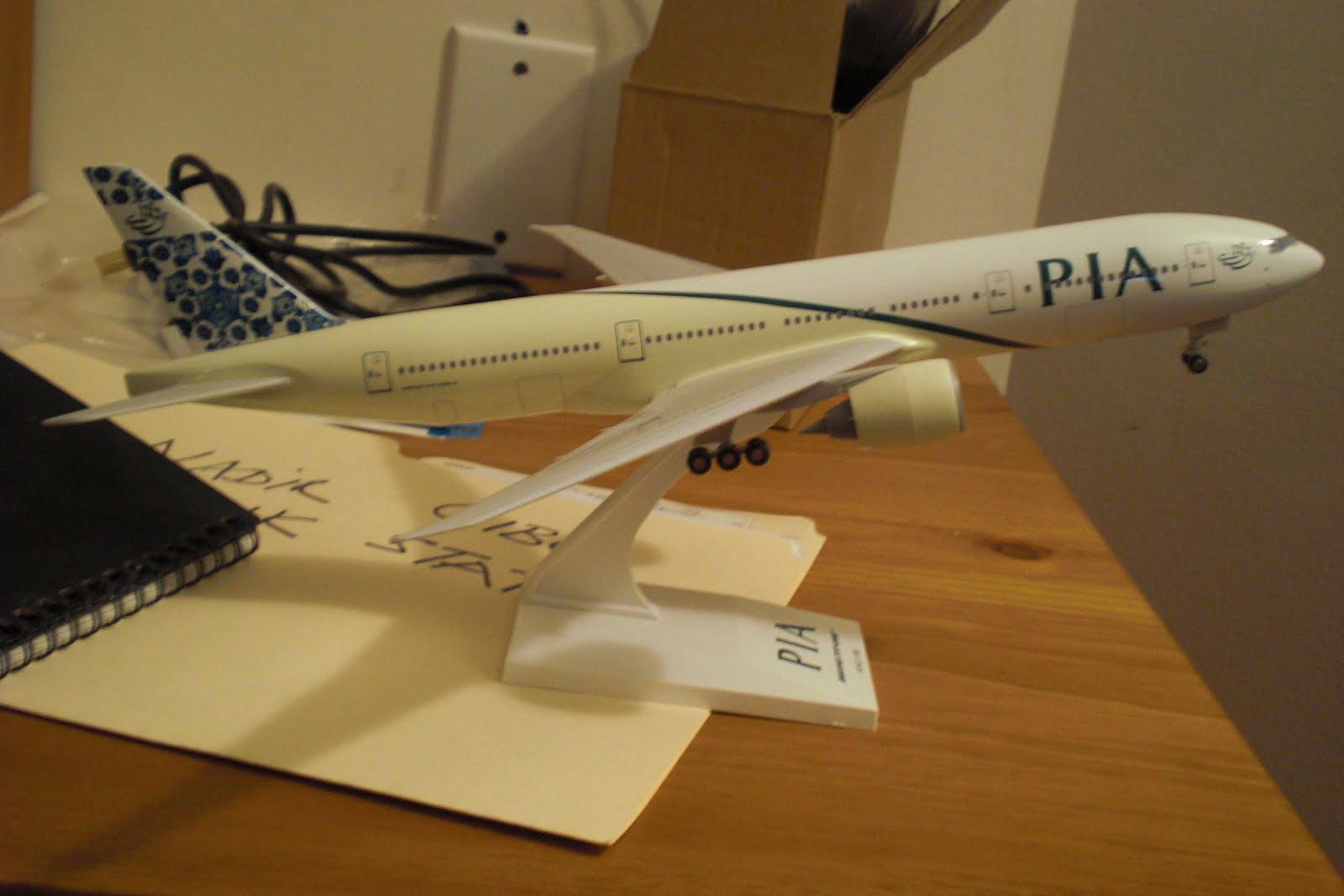
PIA Boeing 777-240ER 1:200 scale snap-fit made by skymarks:


PIA Boeing 777-240LR snap-fit model 1:200 scale made by skymarks:


Boeing 737-800 in Boeing livery 1:200 snap-fit scale made by hogan wings:


Airbus 330-200 1:400 scale metal diecast made by dragonwings:

Airbus 340-500 1:400 scale metal diecast made by dragonwings:

Dash-8 Q400 1:400 metal diecast made by giminijets:

Boeing 737-200 1:400 metal diecast in old Boeing livery made by aeroclassics:


Boeing 737-400 Westjet 1:300 scale diecast model made by Daron:

Gulf Air Boeing 767-200(ER?) 1:200 snap-fit model (brand unknown):


I also posses an additional Pakistani flag tail for my two Boeing 777s.
As seen on the 240ER:

And the 240LR:

A 1:200 scale snap-fit Airbus 300-600 of Zero-G made by hogan wings: (click on images to enlarge)


PIA Boeing 777-240ER 1:200 scale snap-fit made by skymarks:


PIA Boeing 777-240LR snap-fit model 1:200 scale made by skymarks:

Boeing 737-800 in Boeing livery 1:200 snap-fit scale made by hogan wings:


Airbus 330-200 1:400 scale metal diecast made by dragonwings:

Airbus 340-500 1:400 scale metal diecast made by dragonwings:

Dash-8 Q400 1:400 metal diecast made by giminijets:

Boeing 737-200 1:400 metal diecast in old Boeing livery made by aeroclassics:


Boeing 737-400 Westjet 1:300 scale diecast model made by Daron:

Gulf Air Boeing 767-200(ER?) 1:200 snap-fit model (brand unknown):


I also posses an additional Pakistani flag tail for my two Boeing 777s.
As seen on the 240ER:

And the 240LR:

Sunday, February 20, 2011
How PIA could possibly take advantage of American aid and modernize it's fleet
Since the American administration is trying to improve Pakistan's infrastructure through aid programs in return for getting Pakistani support for the war in Afghanistan, Pakistan International Airlines (PIA) and the Pakistani government should try and take advantage of the program.
The Pakistani government could try to include PIA's fleet modernization as part of the aid package and request the Obama administration to put Boeing in direct touch with PIA officials to lease new generation Boeing 737s to PIA.
It is doubtful Boeing will put up newer planes for lease, but under the influence of the America government, they might go out of their way and strike a long-term contract with PIA.
As most readers may know, PIA's narrow body Boeing 737s are extremely outdated as they were inducted in 1985-1886.
Also what most readers may know that PIA is in no financial position to purchase newer aircraft at this stage so the best option for fleet modernization is leasing new planes on long-term contracts instead of buying them.
There were also talks with Boeing of inducting newer generation Boeing 737-800s and a Boeing artists impression was released as it is done traditionally when airlines consider newer aircraft as seen here and here.
Getting long term deals is in the best interests of PIA as a long term lease can be the equivalent of a quarter or even sometimes half the lifetime of a purchased plane.
Though PIA's Boeing 737s need modernization badly, the Airbus 310s will also need to be eventually replaced and the best alternates would be Boeing 777s or Airbus 330s.
But since Pakistan is currently in a political and economical partnership with America, it enjoys a lot of aid programs from that country, which is why the government and PIA should take advantage of the aid programs and try to seek newer Boeing substitutes for it's older planes.
The Pakistani government could try to include PIA's fleet modernization as part of the aid package and request the Obama administration to put Boeing in direct touch with PIA officials to lease new generation Boeing 737s to PIA.
It is doubtful Boeing will put up newer planes for lease, but under the influence of the America government, they might go out of their way and strike a long-term contract with PIA.
As most readers may know, PIA's narrow body Boeing 737s are extremely outdated as they were inducted in 1985-1886.
Also what most readers may know that PIA is in no financial position to purchase newer aircraft at this stage so the best option for fleet modernization is leasing new planes on long-term contracts instead of buying them.
There were also talks with Boeing of inducting newer generation Boeing 737-800s and a Boeing artists impression was released as it is done traditionally when airlines consider newer aircraft as seen here and here.


Getting long term deals is in the best interests of PIA as a long term lease can be the equivalent of a quarter or even sometimes half the lifetime of a purchased plane.
Though PIA's Boeing 737s need modernization badly, the Airbus 310s will also need to be eventually replaced and the best alternates would be Boeing 777s or Airbus 330s.
But since Pakistan is currently in a political and economical partnership with America, it enjoys a lot of aid programs from that country, which is why the government and PIA should take advantage of the aid programs and try to seek newer Boeing substitutes for it's older planes.
Wednesday, February 16, 2011
Modified image of AP-001
My own livery of the Pakistan Air Force (PAF) VIP transport plane registered AP-001. I tried to add an Urdu script alongside the English titles but unfortunately the software I used doesn't seem to recognise non-Latin script. (click on image to enlarge)


Saturday, October 30, 2010
How PIA could possibly reduce fares on Haj operations
During Haj operations in Ramadan and Eid Ul-Adha, Pakistan International Airlines (PIA) receives a large amount of passengers to Saudi Arabia.
If I am not mistaken, having a large amount of passengers per flights, makes it possible for PIA to offer lower fares to each passenger.
On the return leg however, I've read that the fares are relatively high due to much less passenger load on the return flights.
Such high fares would only discourage passengers from using PIA to fly back to Pakistan for Eid holidays or any other reason during Haj season.
A good solution would be for PIA to reduce fares is by stopping at lower density routes on it's return leg from Haj flights.
For example, PIA currently uses it's Boeing 747-300 Combis on Haj operations. On the return leg the flights is supposedly mostly empty.
On it's return leg, the airline could stop in Muscat, Sharjah, Abu Dhabi or any other nearby destination on it's route back to Pakistan. This will allow it to handle more passengers and possibly cargo in one flights, instead of sending several planes all over the Gulf region.
This method could generate more profits, not just by reducing fares, but also by having more planes to spare on domestic and other routes especially the Eid season being a high travel season in Pakistan and the Muslim world.
If I am not mistaken, having a large amount of passengers per flights, makes it possible for PIA to offer lower fares to each passenger.
On the return leg however, I've read that the fares are relatively high due to much less passenger load on the return flights.
Such high fares would only discourage passengers from using PIA to fly back to Pakistan for Eid holidays or any other reason during Haj season.
A good solution would be for PIA to reduce fares is by stopping at lower density routes on it's return leg from Haj flights.
For example, PIA currently uses it's Boeing 747-300 Combis on Haj operations. On the return leg the flights is supposedly mostly empty.
On it's return leg, the airline could stop in Muscat, Sharjah, Abu Dhabi or any other nearby destination on it's route back to Pakistan. This will allow it to handle more passengers and possibly cargo in one flights, instead of sending several planes all over the Gulf region.
This method could generate more profits, not just by reducing fares, but also by having more planes to spare on domestic and other routes especially the Eid season being a high travel season in Pakistan and the Muslim world.
Subscribe to:
Posts (Atom)